And the winner of the 2023 Mercury Music prize is…….Ezra Collective. Excellent choice. A jazz group winning a major popular music prize shows how the genre is central stage and gives a real filip to events such as the Sidmouth Jazz Festival that I am part of the organising team. Ezra Collective’s album Where I’m meant to be is excellent, mixing afro beat with jazz and hip hop, showing their London roots. Accepting the award, drummer Femi Koleoso thanked Tomorrow’s Warriors and the Total Refreshment Centre community space where the group and the new London Jazz scene emerged. Taking Brian Eno’s concept of Scenius (or group genius) you need free spaces to support collective creativity, central locations where people can hang out and explore their creative selves. I learnt about playing in bands and explored musical styles through having the time and space to explore, experiment. Neoliberal gentrification housing issues that are sweeping our lands are cutting bands like Ezra at source. They will disappear without a proactive moment now to protect community spaces – it is a human need for us all.
Femi also thanked music education, schools, colleges, tutors who support young musicians to develop and explore their fields. Ezra Collective came through Tomorrow’s Warriors, a school that develops young jazz musicians in London and is expanding their reach across the UK and beyond, helping musicians from underprivileged backgrounds in Devon for example to explore the joys of jazz. In working on the Sidmouth Jazz Festival, I also want to see the expansion of jazz in rural areas, to see urbanities in the fields, swimming in the sea, hanging out on beaches, playing, dancing and listening to music, spreading our rich cultures to all parts. Ezra Collective have just made a big moment in that direction.
A great exhibition of influential women artists from 1970-1990 is coming to the Tate Britain from the autumn. Features many of the artists interviewed in my book with The Raincoats Gina Birch as the poster image
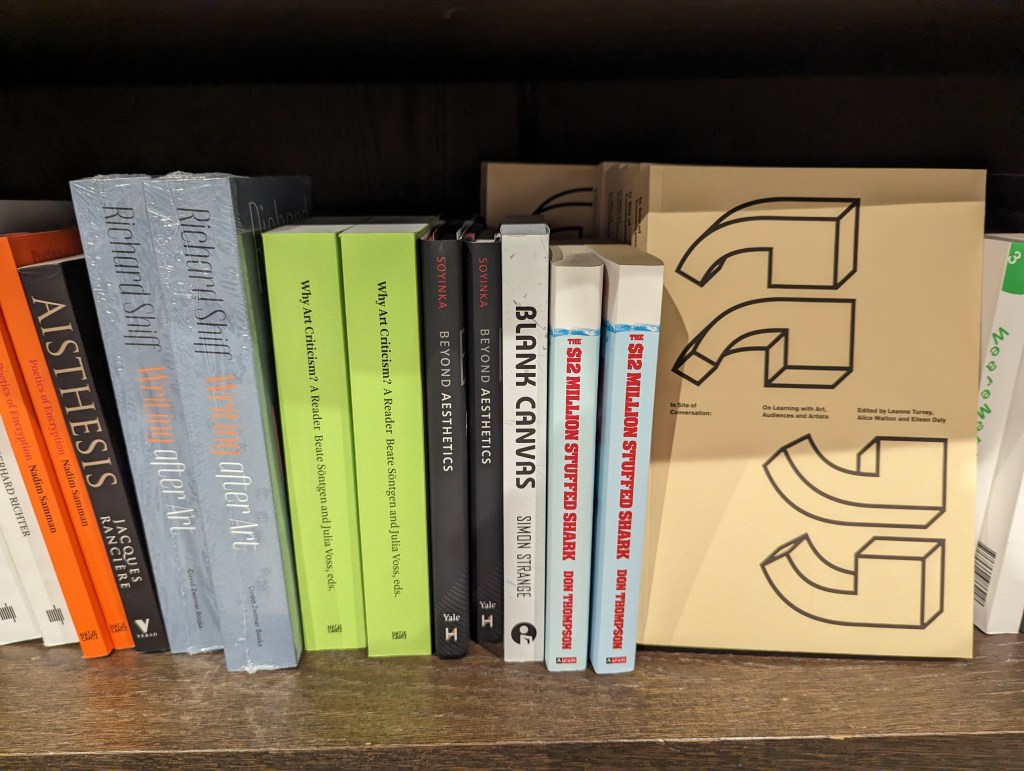
It is truly delightful to witness your creation venturing into the vast world, particularly in your most beloved locations, like the extraordinary bookshop at the Tate Modern. You have the option to procure Blank Canvas: art school creativity from punk to new wave directly from the publisher (as well as from all reputable bookstores). The joy of encountering your work in beautiful artistic spaces is heartwarming and exciting.
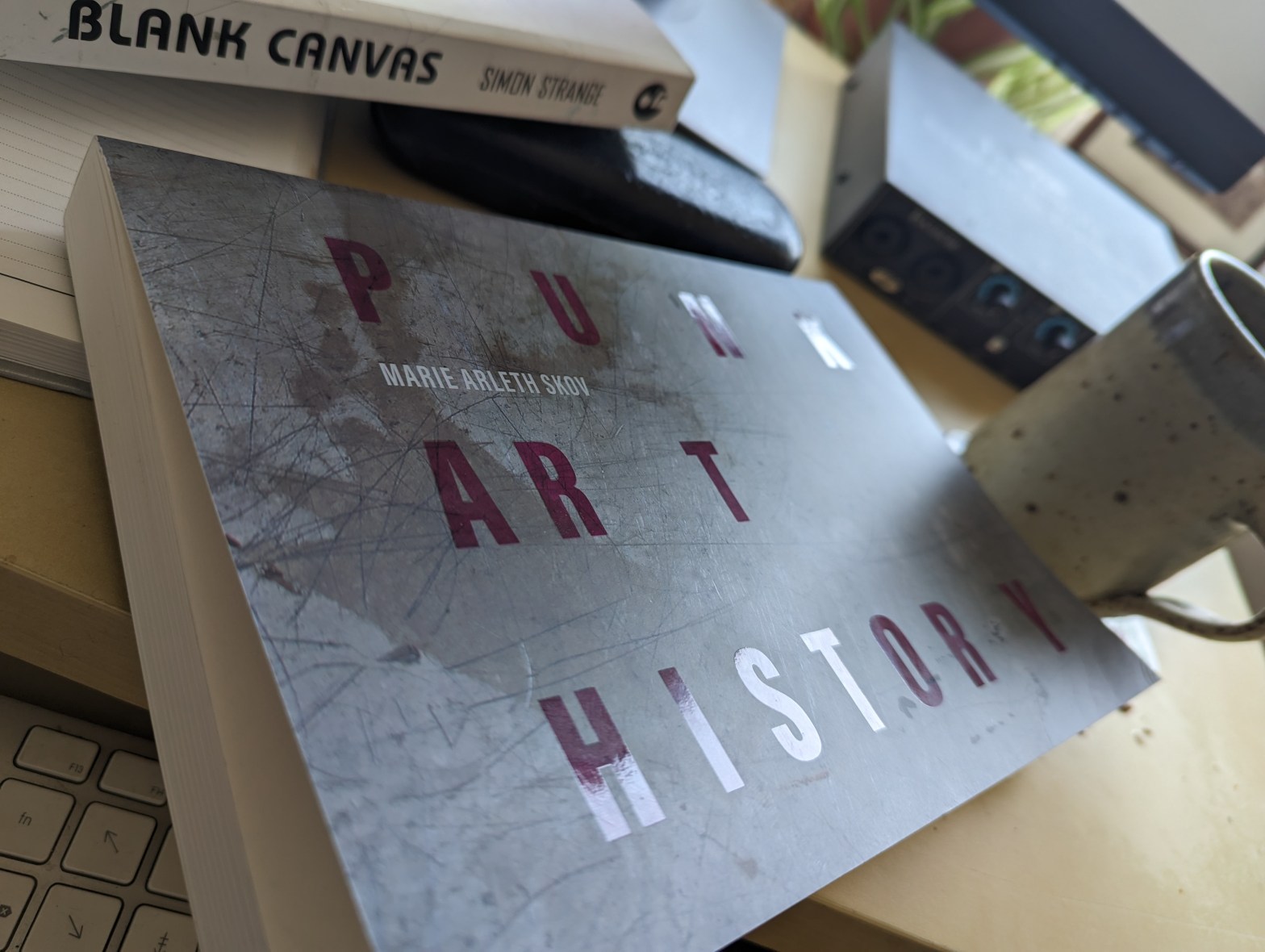
I am a punk in spirit but not in music making reality. My brother was, painting half of his face blue and being a teenager in 1977. I am naturally affiliated to post punk or new wave but the word ‘punk’ is a strong symbol, something which emphasises innovative thought and new directions, anarchic and beyond the avant-garde. Punk as a word has become much more than its music; it’s a statement of intent. Marie Arleth Skov’s gorgeousPunk Art History highlights the visual impact of this time in history, providing both an archive and forward facing view of audio and visual connections, still as relevant now.
Part of the wonderful punk scholars Global Punk series. Increasingly beautifully designed and playing with the edges of academic and popular publishing, Intellect publishing provide the space for this DIY aesthetic to exist, which is an incredible feat in the fine margins they work within. Skov’s style of writing is accessible and playful in a way that supports the ethos of the series.
It is another sure fire connection between the art and music worlds that inspired contemporary music through the punk baton. The book is an art piece.
Marie clearly reviews the time period of punk, centering it around those key times from 1976-78. Unlike Jon Savage, for me highlighting the Sex Pistols, the Clash and especially Genesis P-Orridge’s Coum productions feels very London centric.The connection between COUM and punk is not one that I would always make as Throbbing Gristle were often a low, slow, industrial machine. Not the speed of punk which Skov expertly highlights. More like Gong or other hippie favourites. I would look at defining punk as for me Adam and the Ants for example weren’t punk but new wave or even new romantics.
PAH beautifully reviews connections between Andy Warhol and punk, Conceptual Art, Fluxus, the Situationists and Dada. Art and Language were also another key important connection. The image comparisons between Warhol’s Elvis and Gavin Turk’s Sid Vicious for example, are informative and visually exciting.
DIY expressions through Xerox and Super 8, the copiers and filmmakers of punk are explored. Derek Jarman was an art school guest lecturer at Hornsey. The rise of MTV and video through the visualisations that punk and post punk/ new wave brought into the pop music sphere.
A second book could explore Punk Art as a personal element – fashion and dress sense through DIY and daring. It is a brilliant supporting text to Ogg and Bestley’s The Art of Punk introducing context. Punk Art History is an excellent source of punk art so it would be great to have a follow up that connected the Buzzcocks, Exploited, the Damned, Stiff Little Fingers, Sham 69 etc.. I explain in Blank Canvas how Gina Birch of the Raincoats and Dexter Dalwood of the Cortinas for example forged a continuing visual art career.
Go buy this great historical artefact direct from the publisher or from your favourite independent book seller.
It’s a few weeks since the heady heights of the Sidmouth international Jazz and blues festival 2023, an amazingly successful venture led by the unstoppable Ian Bowden and crew. He has created a beautiful and professional event that garnered such great responses as ‘if Carling did festivals’ or ‘ what an outstanding weekend, so well organised, great bands and we hope it continues for years to come’.
My role was to support Ian when I could, help with curating bands and compere the main stage. All good fun. I was so pleased to have secured the simply superb Hannah Williams and the Affirmations, the heart wrenching Roland Gift and most talented of talented Courtney Pine somehow rocking out this sleepy and beautiful Devon town like never before. The Jazz Defenders were incredible whilst Indira Roman and Aji Pa’ti knocked it out of the park.
Every act was wonderful and it feels like a family spirit of musicians is starting to develop in our rural outpost.
Please stay in contact through our website for updates and limited edition merch. See you in 2024 as we welcome you back again
Any kind of artistic connections are made of a synergy which binds and weaves the two resonant forces together. Think John and Yoko or Ian Rush and Kenny Dalglish or any other Liverpudlian duo. Peters and Lee maybe.
It is less common for visual artists to have this same affinity but I love the interconnection between Klimt and Mondrian which is highlighted at their Tate Modern show, open until early September.
We are currently decorating our newly bought bungalow, watching Alan Carr and Michelle Ogundehin’s natural chemistry in the wonderful design masters. Combining textures and styles for the contestants is the most difficult element so the Klimt/ Mondrian double act seems a perfect marriage of colour and form, minimalism and flow, the perfect template for informing our own design decisions.
Delving into the deep recesses of what it means to be a creative musician opens up an array of projections and possibilities, a question that is impossible to answer but which I feel needs to be asked. My interest is as a Higher Popular Music Education (HPME) researcher seeking to discover whether university education is supporting current popular musicians to explore their true creative selves. As neoliberalism sweeps through the UK university sectors employability is linked to course design and outputs; I wonder whether HPME can in part replace record company A+R departments who gambled, took risks with young creatives and provided them with the time and mentoring to achieve their maximised music identity. If we are going to mentor musicians then surely it is supporting their creative journey which is vital.
In traversing the slopes of creativity, I pose an open question for exploring what it means to be a creative musician, a conversation which will support the debate and open pathways of exploration. Through jazz, classical, dance, punk, rock and other global music genres are there interconnections which help to define what a creative musician is?
There are many elements of creativity that connect to perceived elements of musicality, which resonate with all elements of the creative arts including flexibility, associative thinking (chance and freedom), collaboration, metaphorical thinking (comparative) and synthesising (mixing conscious and unconscious) (Vaughan, 1977, p.72). It is the interconnection between conscious and unconscious thought processes that help to define creative artists. Richard David James (Aphex Twin) used dreaming as a way of exploring the unconscious state, recalling sounds, motifs and atmospheres which he would create in his waking state. Teaching at the German Bauhaus school in the early 20th century, Johannes Itten, used breathing exercises and movement to help students move into trance-like states, to reduce the impact of considered thought.
Maybe we need to leave musicians alone or press the reboot button located on their person. Engaging with the concept of natural artistic creation, musicologist Michael Spitzer argued that musicality is innate within the human species and the naturalness to perform and create it is stunted through a series of cultural phenomena. Within art, cutting back to the original naturally creative self is achieved through unlearning, where previous education and the creation of a blank slate on which to provide the space and inspiration to explore creative avenues is attained. British ethnomusicologist John Blackingdiscovered that the Venda people of South Africa believed that music existed as something naturally assumed through the human body and socialised experiences; trance induced states and automated learning from birth assumed an automatic imbibing of musicality, where music is life: life is music.
Correlating to the emotional and cognitive elements of creativity, arriving in the flow, being lost within artistic creation intrigued Hungarian psychologist Mihalyi Csikszentmihalyi. Teaching student artists to recognise when they are in a flow state and techniques on how to get there, should be an ingredient of popular music education. Research psychologist and former partner of Mick Fleetwood (Mac), Jenny Boyd interviewed musicians about their creative experiences discovering numerous recollections about getting lost in music, being in a flow state, reducing the conscious impact on the creative process. Boyd reflected on Carl Jung’s theory that ‘the centre of the total personality lies midway between the unconscious and the conscious,’ with this transference being an important point. Her findings revealed that some musicians used meditation to transcend to ‘no mind’ and ‘referred to a kind of mental ‘stillness’ necessary for the unconscious to make itself known through creative expression’
Alternatives to exhorting technical proficiency, within my own research (Blank Canvas) I explore connections between UK art education and the creative development of popular musicians. Some of the main elements of creativity relate to interdisciplinary features. I argue that musicians and music educators should look away from music specific ideals to develop musicianship, with art schools being one avenue overdue for in depth exploration. Musicians could expand their outlook to include subjects such as philosophy, psychology, culture, politics and science for example to help inform practices.
Inspired by the Bauhaus, Belgian socio-cultural theorist Thierry De Duve believed that the closer someone existed to a newborn state then the greater their natural level of creativity. He also crucially detailed three periods (3 is always the magic number) within the field of visual arts, with the three main elements of the third section of the schema coinciding with key components of popular musicians who exploded through the 1960s and 70s: Attitude – Practice- Deconstruction.
Looking at these independently then:
Attitude – is a difficult word to define but can be seen as an artist who takes risks with a radical edge, not being a slave to conformity or tradition but aiming towards pure creativity, without allowing anything to stand within their pathway.
Practice – can refer to a few constituents but in general connects to the creative process, letting this evolve and revelling in the journey. It can also be related to the actual physical practice required to assist in the development of enhanced musicality.
Deconstruction – again has meanings which intersect, including deconstructing collective ideas but also deconstructing the music itself into constituent parts.
Taking these three main elements into consideration could be vital for the nurturing musician who is looking for a framework of creativity, examining the main elements then utilising work that is personal and true to the self alongside an openness to collaboration, whether with other musicians or themselves.
Entering the traditional music realm, key elements of musicianship could be seen as pitch and rhythm but exactness within either doesn’t tell the whole story for a creative musician. I believe that all humans have their own natural pitch and timing capabilities and emphasising or enhancing these is an area of interest for the creative musician. TheVelvet Underground’s Mo Tucker drummed with a natural non-linear expression counter to exactness exploited by the lifeless click used by many drummers and rhythm exponents. The random swing of an Akai MPC drum sampler gave a machinic but naturalness to early hip hop programmed beats.
Art school students such as ambient pioneer Brian Eno and post punk musician Gina Birch invited chance induced and randomisation into their music making, inspired by conceptual art. Bill Drummond of the KLF (alongside managing Echo and the Bunnymen and Teardrop Explodes) believed in conceptual processes where the idea is of equal or greater importance than technical efficiency or outmoded musicianship. Alice Fox of 80s band The Marine Girls still employs processes of unlearning extended from the Bauhaus, another punk infused artist who saw the value in recalibrating, trying to stop playing the same patterns which define you and reflect your learned traits. Allowing the system to take control as in the artistic science of cybernetics where the process is complexly cross-connected where organism is key, as it is the art piece and everything which exists around it which is where the magic happens.
Through my research it is simplicity that is an important element, where the concept defines the process of creation. Minimalist music inspired by the four grandees (La Monte Young, Steve Reich, Terry Riley and Phillip Glass) embedded itself into popular music genres, stripping away extraneous parts which masked the bounce or frequencies of music. Minimalism = simplicity, providing space between the notes where the conceptual nature allowed the music room to breathe and the listener the chance to place their own meaning within the music. I believe this is a vital element of dance music genres in particular.
Music writer Simon Reynolds in his opus on dance music (Energy Flash), stated that iconic Detroit house producer Juan Atkins undertook philosophical explorations whilst compiling DJ sets, trying to enter the mind of the creator of a track to work out where the next one should match. As a non-traditional musician, the mind is an important tool for DJ’s and electronic producers. Many musicians aim to mimic but for the artists within the field, being innovative and original is a key goal. Bristol musician Tricky shared his creative philosophy: ‘I wanted to make something that no one’s ever heard before – I wasn’t interested in anything else’ (Fisher, 2014, p.47)
We are in a period within the music industry of saturation, where from 60,000 albums a year in 2002 rising to almost that number a day in 2021. How do you break through this noise, a morass of content waiting to engulf you. Gatekeepers still exist but competition is fierce so originality and innovation might be the only way to break through; surely the music buying public are ready to engage with this. Exploring the past to make judgements on the present – sociocultural theorist Mark Fisher coined the term popular modernism where a modernist avant-garde exploration for future innovation is matched with a populist reach. Fisher saw in post punk, a reworking of the past where the present or the future is unknown creates work which has longevity and depth, a concept where the interconnection of experimental and commercial ideas merge. Surely this is where we need to emerge.
To be conscious of the unconscious is a vital element of creativity, this interplay which defines the connection between known and unknown the learnt and unlearned – musical creativity is a bi-play of numerous elements but maybe it is this intersection which should be concentrated on when supporting musicians to develop their creative selves. Focusing on the development of creative expression in musicians is key.
References
Boyd, J. and George-Warren, H. (2013) It’s not only Rock ’n’ Roll. London: John Blake Publishing.
Fisher, M. (2014) Writings on depression, hauntology and lost futures. Zero Books.
Spitzer, M. (2021) The Musical Human: A history of life on earth. Bloomsbury.
Vaughan, M. (1977) ‘Musical Creativity: Its Cultivation and Measurement’, Bulletin of the Council for Research in Music Education, (50), pp. 72-77.
In an era of neoliberalism and Thatcher dominated landscape in the UK its reassuring to view buds of activism and revitalism in the creative arts education sectors. In Tim Foster’s lovely review of my book Blank Canvas for Echoes and Dust he noted the connection between art schools of the Bauhaus, Black Mountain College (BMC), and the UK with Dartington always an experimental outlier. Both Black Mountain and Dartington existed in stunning rural locations but with an urban experimentalism and social consciousness which aimed for improved human existence, for everyone, through art. Dartington Art School is reborn and offering amazing courses which combine visual and auditory arts with social justice, offering practice which engages with the self and the land. I fancy trying ‘turner’s tides and twilight’ or ‘the labyrinth and the dancing floor’. The prices are good value too.
My studio has a beautiful image of Dartington created by contemporary artist Ant Garratt, whose work is beautifully Turner-esque but with a modern tropical feel. Ant’s work is gaining increasing depth from his earlier beautiful but more minimalist compositions, and artist with visual and auditory sensibility.
Transporting the ideals of BMC and Dartington to the French Pyrenees, Camp.fr offers sonic and nature based courses with experts in their field including Sarah Davachi, Gavin Bryars, Deerhoff and Actress. Mixing minimalist cool with the broad expanse of nature. Black Mountain College was built by students and staff, existing as a breeding ground for the Robert’s Motherwell, Rauschenberg and De Niro: “the school resembled a funhouse hall of mirrors, a space that refracted and distorted anxieties in early Cold War America” (Brigid Cohen, 2012)
Go explore and find yourself.
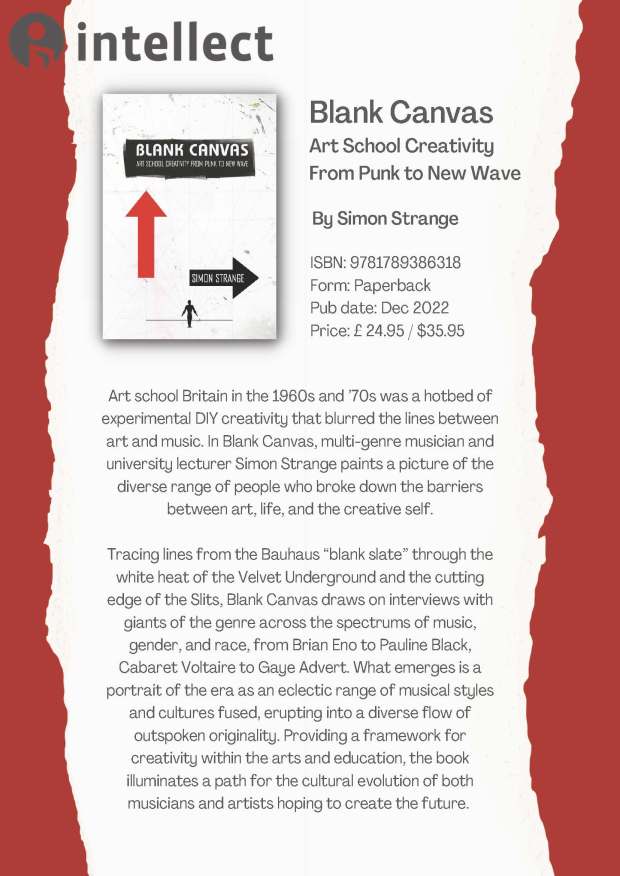
BLANK CANVAS : ART SCHOOL CREATIVITY FROM PUNK TO NEW WAV
Cohen, Brigid (2012), Stefan Wolpe and the Avant-Garde Diaspora, Cambridge, MA: Cambridge University Press.
Do you prefer to read Fiction or non-fiction books? There was a great thread on Twitter about whether you can learn more about philosophy reading fiction rather than reams of philosophical texts. Jean Paul Sartre has both covered for you ad nausea. I tend to veer between reading true or made up stories i.e through my PhD I couldn’t read fiction as my brain was consumed with trying to know everything about global culture from the last 2 centuries.
I think it might be time to dive into some Dostoyevski. Or re-read Zen and the art of motorcycling for the 100th time. Voltaire, Camus, Milan Kundera and the Unbearable Lightness of Being. Or Don DeLillo. Perfect escapism for the seriousness of Eurovision. The weekend starts here.
Buying on Amazon is easy. You’re all set up and ready to go. Unfortunately they are the bad guys and it is much better for the world in general if we buy our books from smaller booksellers. They are starting to bloom across the country with Bookbag in Exeter, Gloucester Rd Books in Bristol and MrB’S Emporium in Bath great examples.
The Bookshop.Org are a great online sources as well for buying great books and not feeding the conglomerate Amazon animal.